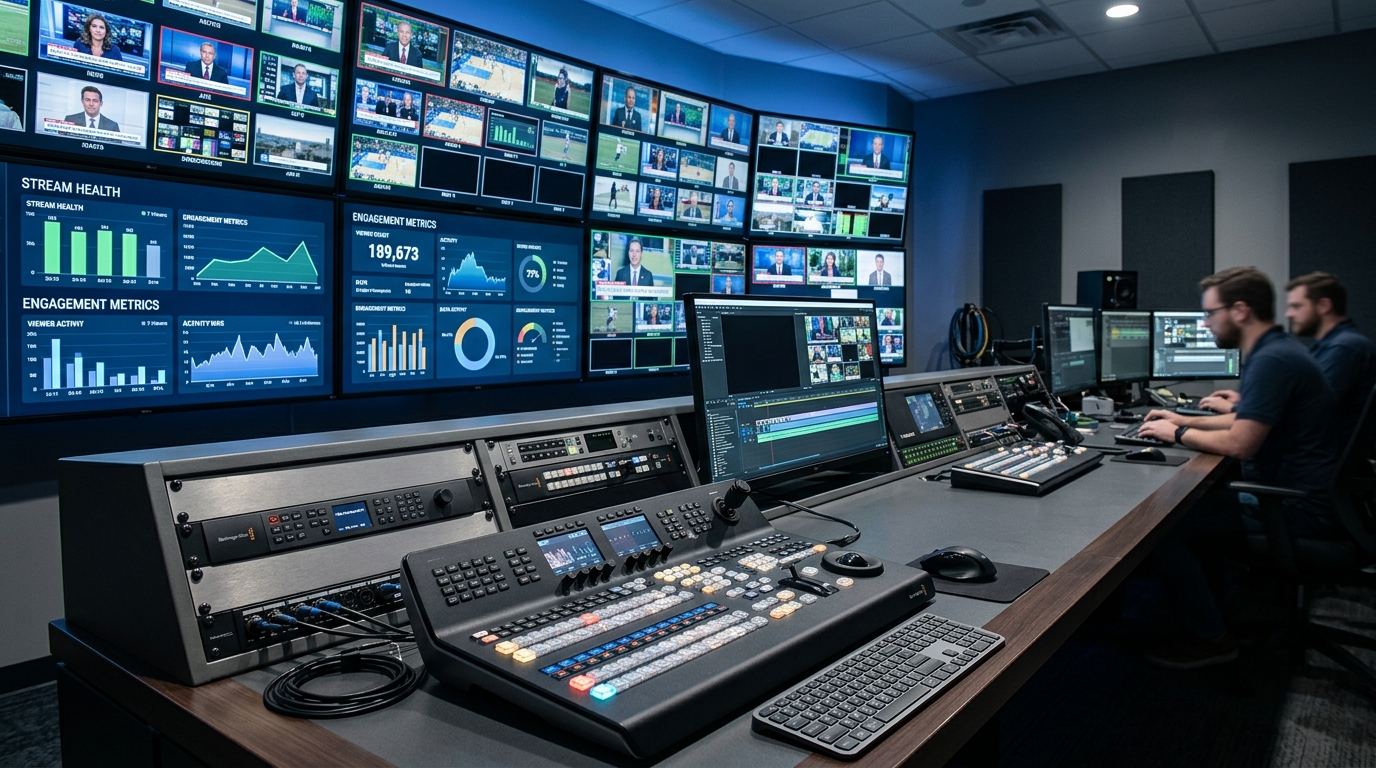


Key Takeaways
- Facebook and Instagram together captured 54 percent of global social media advertising revenue in 2025, close to 70 percent excluding China.
- Digital partners syndicate back-catalogue IP through zero-cost, revenue-share models.
- Meta's Reels platform has surged to a $50 billion annual run rate.
- Integrating Creator Collaboration breathes new relevance into legacy broadcast formats.
- Professional Social Media Management guarantees the distribution scale needed for high ROI.
The Great Broadcast Pivot: Cashing In on Social Video
Linear television ad revenues are facing structural headwinds, forcing independent producers and rights holders to re-evaluate where audiences actually consume video. As viewing habits migrate from traditional broadcast schedules to digital feeds, advertising capital has followed. Omdia's Social Media Advertising Market Landscape 2026 report finds that Facebook and Instagram together accounted for 54 percent of global social media advertising revenue in 2025, rising to almost 70 percent once China is excluded. Omdia also forecasts that online video advertising will grow from $309 billion in 2025 to $540 billion in 2030, lifting its share of total TV and video revenues from 40 percent to 53 percent, while linear TV advertising's share falls from 16 percent to 11 percent[1].
For television producers sitting on extensive program libraries, leaving archive tape in digital vaults represents lost yield. Broadcasters once held the monopoly on long-form narrative attention, but modern digital platforms now deliver the scale, targeting and programmatic monetization necessary to support premium video formats. Tapping into this shift requires treating social platforms not merely as promotional barker channels, but as dedicated syndication windows capable of generating standalone operating margins.
- Global linear broadcast ad revenue continues to erode as audiences fragment across on-demand and mobile platforms.
- Online video advertising is forecast to lift its share of total TV and video revenues from 40 percent in 2025 to 53 percent by 2030, while linear TV advertising slips from 16 percent to 11 percent[1].
- Facebook and Instagram together took 54 percent of global social media advertising revenue in 2025, rising to almost 70 percent excluding China, creating immediate liquidity for high-volume video catalogues.
- Modern digital networks provide automated infrastructure to monetise both catalogue titles and active production assets.
How Digital Partners Unlock Back-Catalogue Revenue
Transforming broadcast tapes into profitable social assets demands substantial ingestion, editing and platform-native optimisation. Dedicated video monetisation networks solve this resource hurdle for rights owners through zero-risk commercial models. Rather than requiring production houses to fund internal digital departments or hire costly external agencies, leading digital distribution partners operate on pure revenue-share agreements. The distributor covers the operational overhead of ingestion, re-editing, thumbnail packaging and channel management in exchange for a percentage of generated ad earnings.
Capital investment across the digital syndication sector underscores the massive economic value locked within broadcast archives. At MIPCOM, digital content distributor Merzigo announced a $150 million investment commitment for 2026 to support production companies and studios expanding library assets across digital platforms[2]. This deployment of capital highlights how institutional players view television archives: durable, high-yield assets that generate predictable returns when properly distributed across algorithmic ecosystems.
- Content Auditing: The distribution partner evaluates existing catalogue hours to identify formats with high digital retention and global appeal.
- Asset Ingestion and Re-Versioning: Broadcast masters are split into episodic chapters, compilations and vertical highlights optimised for feed algorithms.
- Commercial Distribution: Content is published across dedicated white-label channels or established publishing networks to generate immediate ad impressions.
- Revenue Share Settlement: Monetisation yields from platform ad pools are split directly with rights owners without upfront capital expenditure.
YouTube vs Meta: Maximising Broadcast ROI
Monetising television formats across digital video requires navigating the distinct commercial engines of YouTube and Meta. YouTube remains the premier destination for searchable, long-tail viewing and structured episodic distribution. Its mature Content ID ecosystem allows rights holders to claim and monetise third-party uploads while driving dependable mid-roll ad revenue from long-form episodes. Conversely, Meta offers unmatched algorithmic velocity across Facebook and Instagram, surfacing archival programming directly into user feeds based on real-time interest graphs.
Meta's vertical video format, Reels, has expanded into a commercial powerhouse: Mark Zuckerberg told investors on an October earnings call that Facebook and Instagram Reels had surpassed a $50 billion annual revenue run rate[3]. This scale makes a dual-platform strategy non-negotiable for television producers. While YouTube builds enduring subscription audiences and steady catalogue revenue, Meta provides rapid reach spikes and short-form monetisation that convert casual scrollers into dedicated viewers.
| Platform Engine | Primary Format Structure | Monetisation Mechanism | Core Distribution Strength |
|---|---|---|---|
| YouTube | Full episodes, compilations, shorts | In-stream mid-roll ads, Content ID claims, channel memberships | Search discoverability, long-tail catalogue view duration |
| Meta (Facebook & Instagram) | Reels, mid-form feed videos, stories | Performance-based creator pools, in-stream ads, Reels overlays | Algorithmic feed discovery, viral sharing, massive monthly active user base |
A successful social syndication framework does not treat these ecosystems as competitors. Instead, production companies deploy a hybrid model: utilising Meta's algorithmic feed to drive high-volume awareness through clips, whilst anchoring full episodes and deep-archive compilations on YouTube for long-term ad yield.
Protecting and Syndicating Your TV IP on Social
Migrating broadcast IP to open digital platforms introduces legitimate operational concerns regarding territorial licensing and intellectual property protection. TV producers frequently operate under complex territorial pre-sales and windowing agreements that restrict where specific titles can be shown. Professional digital distribution networks manage this through rights tooling such as YouTube Studio Content Manager, where upload and match policies apply only in the countries and regions in which the partner declares ownership of an asset[4].
Because ownership can be declared globally or only in selected territories, partners can monetise or withhold a title country by country without disrupting traditional regional broadcast agreements[4]. Furthermore, digital partners leverage automated fingerprinting to detect unauthorised piracy, claiming ad revenue on bootleg uploads rather than issuing disruptive takedown notices. To scale viewership across non-English territories, digital syndicators implement multi-language dubbing, subtitling and cultural re-versioning, allowing single production assets to tap lucrative international ad markets.
- Territory-Level Rights Control: Ownership and policies can be declared per country, so a title is only monetised where the partner actually holds the rights[4].
- Automated Fingerprinting: Digital systems detect unlicenced third-party clips and redirect ad revenue straight to the rights owner.
- Intelligent Re-Versioning: Editors reframe 16:9 master files into vertical formats, adding dynamic pacing and captions for mobile viewing.
- Multi-Language Localisation: Professional dubbing and metadata translation unlock incremental ad earnings across Latin America, Europe and Asia.
Breathing New Life Into Formats With Creator Collaboration
Publishing raw archival files to an empty social channel rarely yields sustained digital traction. Modern social feeds reward personality, community engagement and cultural relevance. To bridge the gap between traditional television programming and digital-native audiences, leading networks integrate strategic social-first media network workflows that combine archive footage with established digital talent.
The Interactive Advertising Bureau's latest annual revenue report calls creator advertising "a core media channel" rather than an add-on, noting that brands are embedding creators into long-term media strategies, operational workflows and even product development, with creator spend reaching $37 billion in 2025[5]. By deploying authentic Creator Collaboration instead of superficial endorsements, production companies can pair unscripted formats, game shows and reality series with popular digital personalities. Creators provide original commentary, react to classic episodes, or host digital companion formats, injecting new energy into legacy intellectual property.
- Format Modernisation: Pairing classic television concepts with digital-native talent revitalises older intellectual property for younger demographics.
- Niche Community Integration: Creators introduce broadcast series directly into active, hyper-engaged digital communities.
- Authentic Storytelling: Collaborative commentary and reaction formats respect original programming while adapting tone for mobile feeds.
- Extended Franchise Value: Digital-first companion shows generate fresh commercial inventory and sponsorship opportunities around legacy IP.
Guaranteeing Scale With Expert Social Media Management
Unlocking the full financial value of television IP requires more than occasional clip uploads. It demands continuous audience cultivation, algorithmic adaptation and full-scale operational oversight. Converting dormant video archives into recurring commercial assets is impossible without dedicated Social Media Management designed specifically for modern publishing ecosystems.
This is where Wavelength transforms digital syndication for TV producers. Operating as a social-first media company, Wavelength manages a powerhouse portfolio of specialised publishing channels and creator networks reaching over 950 million views and people every month, backed by more than 320 million combined followers across Facebook, Instagram, YouTube and TikTok. By leveraging this vast owned distribution footprint, television producers bypass the slow ramp-up of new channels and immediately distribute content to massive, engaged audiences.
- Guaranteed Distribution: Tap into established publishing channels spanning sports, adventure, automotive, lifestyle and entertainment.
- End-to-End Execution: Full lifecycle management covering master ingestion, episodic editing, thumbnail design, publishing and community moderation.
- Maximised Yield: Comprehensive rights management and multi-platform monetization across YouTube long-form, Meta Reels and short-form video ecosystems.
- Zero Upfront Capital: Turn back-catalogue programming into high-margin revenue streams via transparent, performance-driven partnership models.
For television production companies and IP rights holders seeking to monetise back-catalogue assets and launch new social formats, partnering with an established social-first distribution network provides the audience scale, technological infrastructure and operational expertise needed to build a sustainable digital media business.
Frequently asked questions
What is a video monetisation network for TV producers?
A video monetisation network is a digital partner that manages, protects, and syndicates a production company's back-catalogue across social platforms like YouTube and Meta. They operate on a revenue-share model, allowing producers to monetise archive IP with no upfront costs.
How do TV producers make money on Meta and YouTube?
Producers earn through platform ad-revenue splits, branded sponsorships, and Content ID claiming. By partnering with a network that understands intelligent re-versioning, producers can extract maximum value from existing formats across both long-form and short-form video.
Why should TV producers care about Meta's Reels?
Short-form video is dominating digital consumption and advertiser spend. Meta's Reels recently hit a $50 billion annual run rate, making it an essential distribution channel for TV producers looking to drive highly monetisable engagement and reach younger demographics.
Do I lose the rights to my TV IP when partnering with a digital network?
No. Reputable digital networks act as distribution and monetisation partners, not rights buyers. They handle the operational heavy lifting, like copyright management and multi-language localisation, while the producer retains full ownership of the underlying IP.
How does creator collaboration boost TV syndication?
Partnering with digital-first creators introduces legacy formats to new, highly engaged niche audiences. Using strategic Creator Collaboration, broadcasters can modernise their IP and drive massive organic viewership back to their core social channels.